
Several environmentalist campaigners and commentators have recently stated that leading actuaries – the branch of the finance industry that estimates and prices catastrophic risks – have predicted that climate change beyond 2 degrees of warming (beyond pre-industrial levels) would lead to billions of dead, with climate tipping points and feedbacks playing a key role.
For example, Roger Hallam (the co-founder of climate activist groups like Extinction Rebellion and Just Stop Oil) has widely promoted this, repeatedly stating for example that “the British insurance sector once did an analysis showing that at 3 degrees Celsius of global warming, 4 billion people could die — and at 2 degrees, 2 billion lives could be lost. But that’s not even the full truth — it’s the minimum.” Hallam has also noted that the trial of some Just Stop Oil activists (which resulted in acquittal) included the court taking “4 billion deaths at 3°C” as an “agreed fact“.
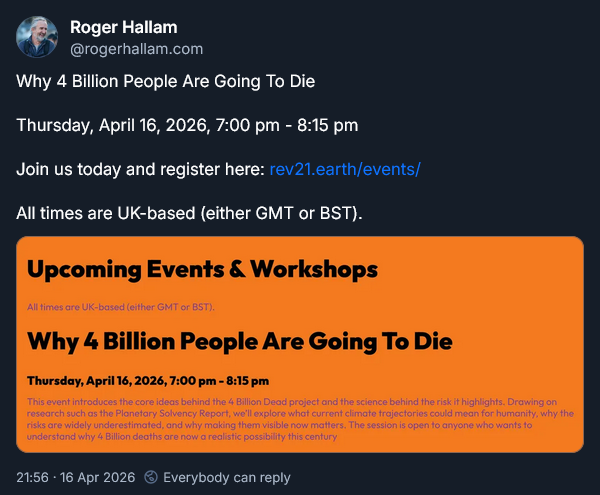
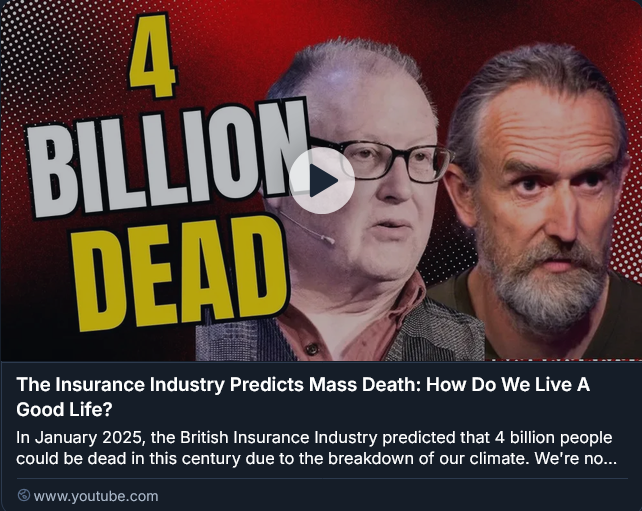
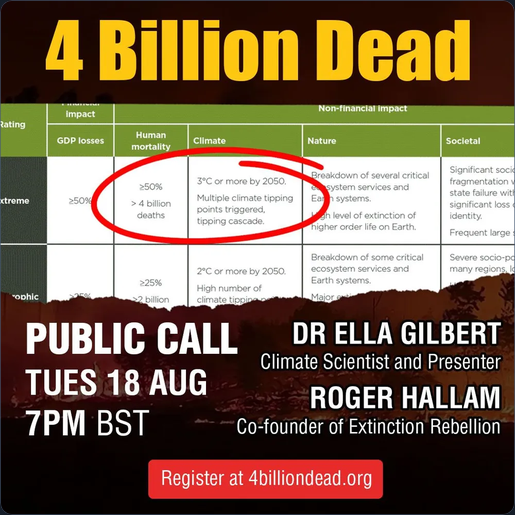
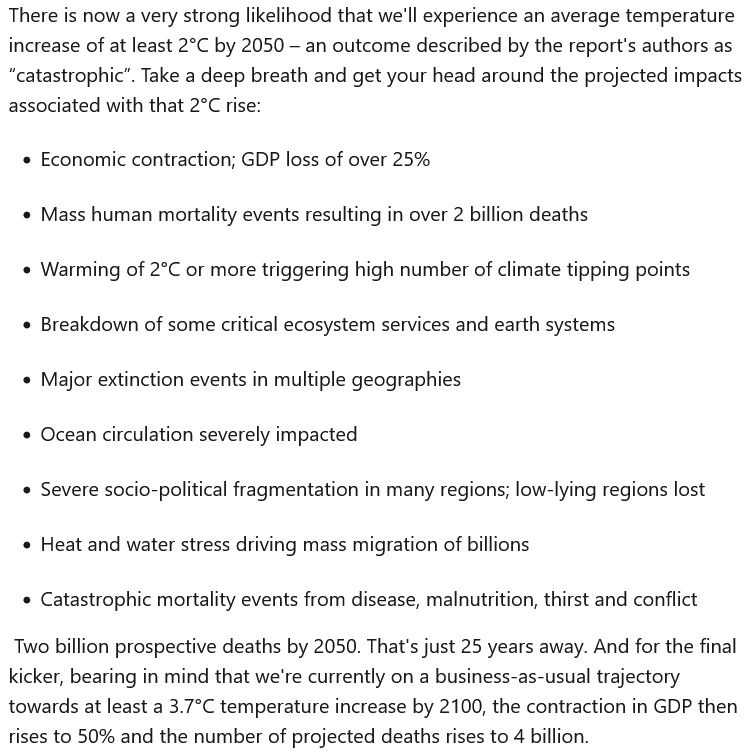
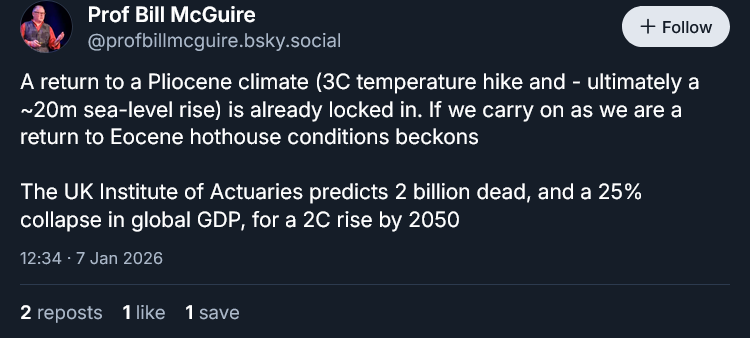
More recently, Bill McGuire (an Emeritus Professor of Geophysical & Climate Hazards), Media Lens, and Jonathan Porritt (an influential longtime environmentalist and campaigner) have repeated this framing, with the former describing it as a prediction by actuaries, and the latter surmising that the analysis means that there’ll be 2 billion dead and 25% GDP loss in only 25 years time (and claiming that the Intergovernmental Panel on Climate Change is too “discredited and corrupted” to say likewise):
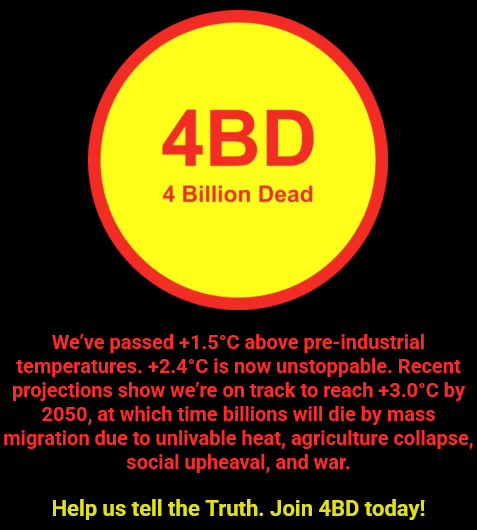
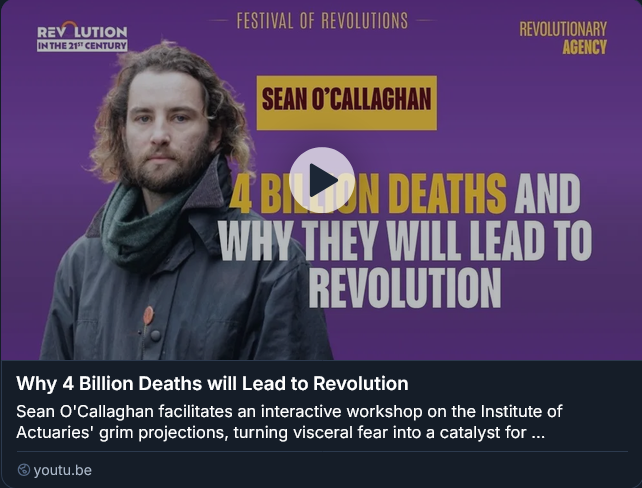
Based on this analysis, Hallam has co-founded a new campaign called ‘4 Billion Dead‘ (4BD), explicitly referencing the 3°C-based number in its name, connecting it to an outlier estimate of 3°C by 2050 (itself based on a linear extrapolation of just the last few years’ warming), and using it as the basis for planning and promoting a new civil disobedience campaign:

So where did these numbers come from then, and are they reliable?
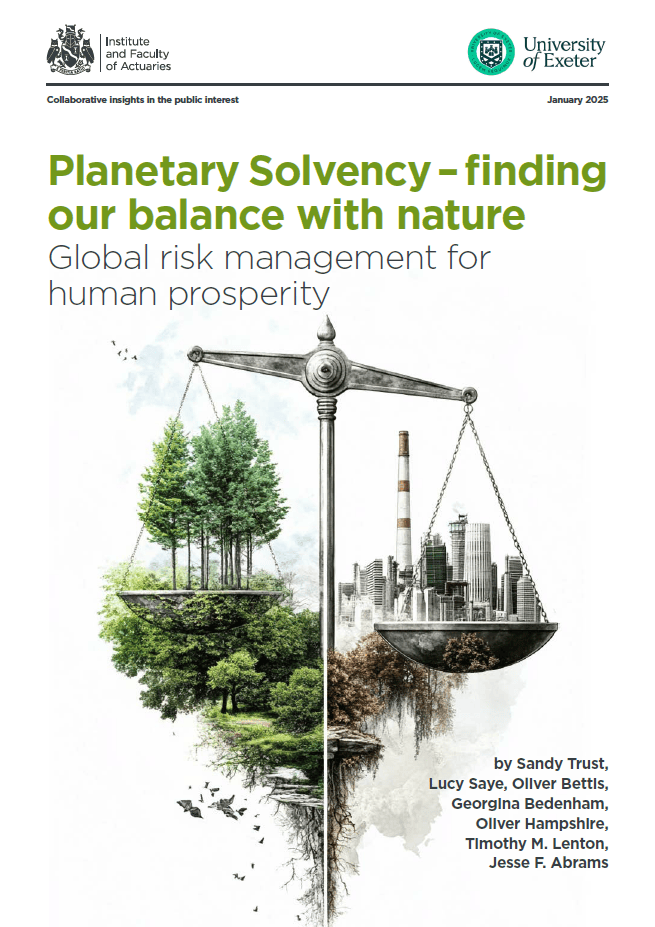
The source is this report jointly written by authors from the Institute and Faculty of Actuaries and the University of Exeter, titled “Planetary Solvency – finding our balance with nature” (pdf):
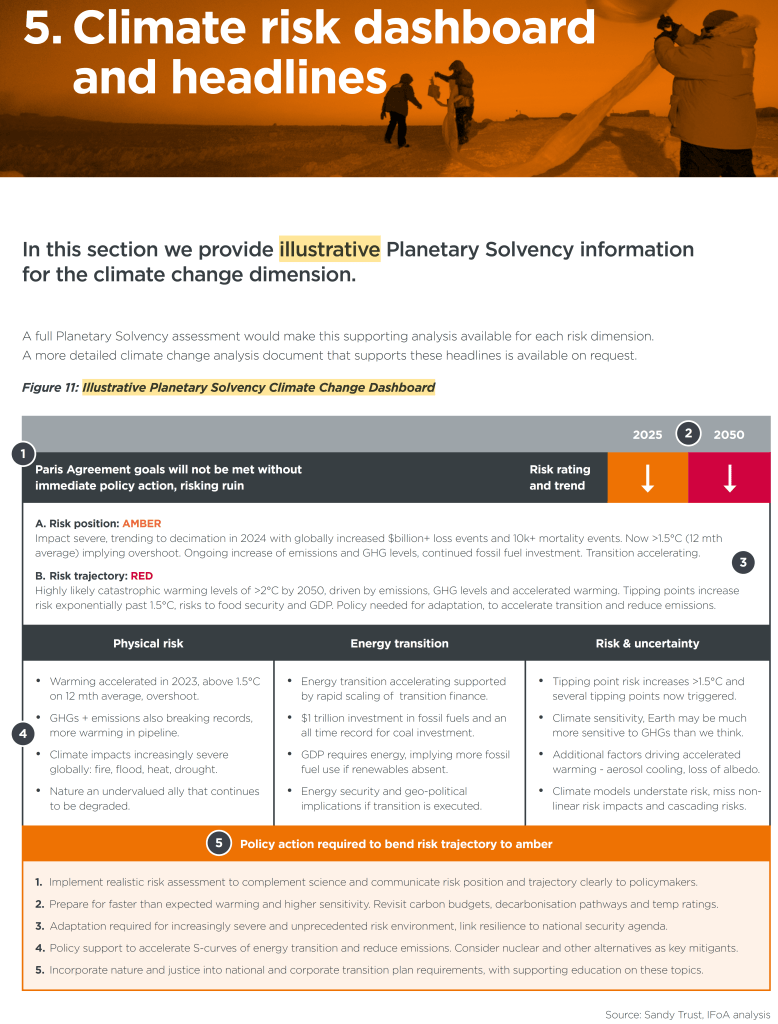
Beyond coining a ‘planetary solvency’ framing for climate risk analysis, the Planetary Solvency report proposes that a ‘climate risk dashboard’ should be created that tricks current and projected climate risks in a similar manner to actuaries do. This is shown via an illustrative dashboard example:
This dashboard is supported in the Appendix by this table (with key bits highlighted, and which you might recognise from some of the social media posts above):
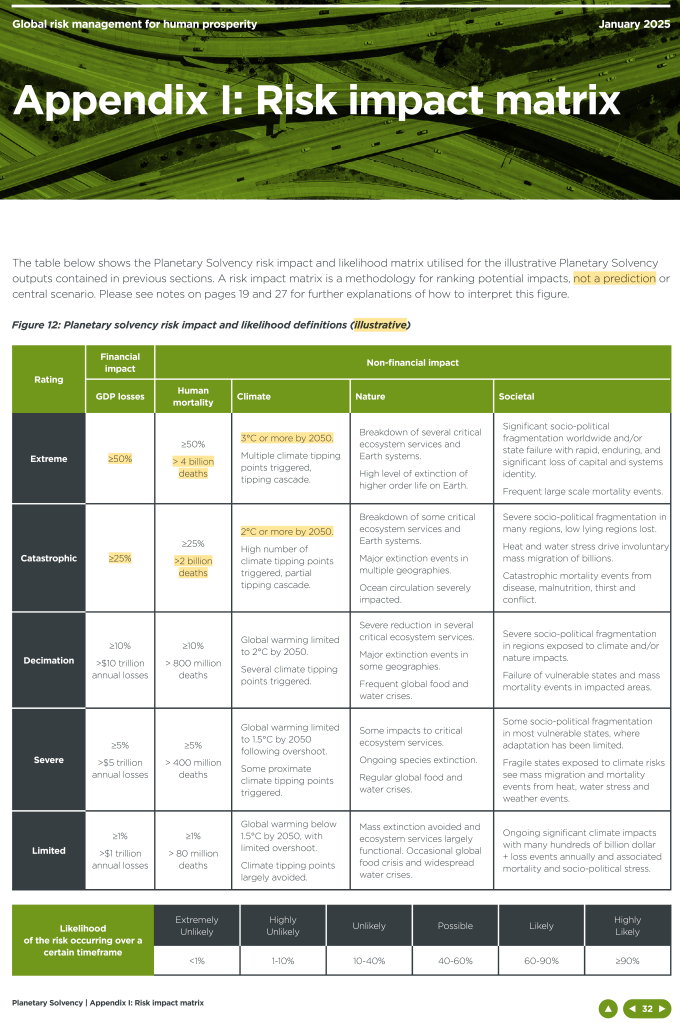
Does this confirm then that the Planetary Solvency report is predicting there’ll be 2 billion dead at 2°C or more, and over 4 billion deaths at over 3°C? It may seem like it, but the answer is actually no – the numbers in this dashboard and supporting appendix are labelled as illustrative (as flagged above both instances, including on the latter that it is “not a prediction or central scenario“).
This means these are just hypothetical numbers to show how such a dashboard would work, and not empirical predictions or projections based on some underlying analysis. This has been confirmed by speaking to one of this Planetary Solvency report’s authors, who agreed that these numbers aren’t based on a specific scientific analysis (with no associated calculations on death numbers presented in the report’s supplementary material either, unlike for GDP), rather being meant as a hypothetical illustration of a worst-case scenario to measure risk against, to be followed later with more detailed empirical analyses. Critically, the worst-case scenario here is implicitly part of a spread of many potential outcomes at 3°C, rather than 3°C itself being the worst-case scenario with these numbers the expected outcome if it is reached.
This means that even taking this report as it stands (leaving questions around the robustness of the magnitude of these death and GDP numbers to other posts), these numbers cannot be treated as predictions by actuaries (which implies an empirically-grounded expectation of the most likely future resulting from 3°C), in contrast to how they’ve been referred to in the earlier quotes, social media posts, and campaigns. Instead, they can at most be interpreted as (and for clarity should be communicated as) provisional expert ‘guesstimates‘ of a potential worst-case scenario, which was used to test-run a climate risk analysis methodology, and is awaiting further in-depth studies to fill in more accurate numbers for use in actual future analyses. (Since first drafting this post, another recent analysis of this claim notes that the death numbers may be based off this paper, but that paper does not in fact contain any such numbers.)
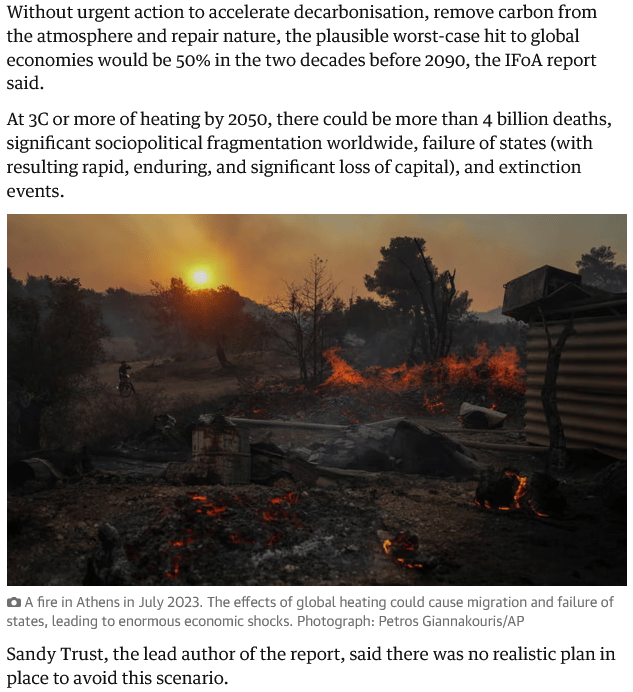
The UK insurance industry has not predicted mass death then, and four billion dead at 3°C is not an agreed fact but a misunderstood hypothetical worst-case scenario awaiting study. Some of the example reactions above could be down to an honest but widespread misreading, given that media outlets at the time reported these numbers like they were empirical estimates and lacked subsequent pushback (e.g. The Guardian article pictured above), and skim-reading the report itself one might miss the “illustrative” labels. It might be argued by some promoters that presenting this scenario as a prediction made by a respected body anyway is useful for promoting appropriately urgent action, but such misrepresentation runs the risk of fuelling scepticism or fatalism too.
It could also be noted that various other estimates have been made of billions potentially dying under high warming scenarios (e.g. from senior scientist John Schellnhuber suggesting extreme warming could cut feasible population to 1 billion, or Johan Rockström stating “It’s difficult to see how we could accommodate eight billion people or maybe even half of that” at 4°C of warming), including from Hallam himself (who suggested on TV in 2019 that climate change could kill 6 billion people this century, which was heavily critiqued at the time). However, none of these have come from empirical analyses, with the first examples instead being based on expert judgement (and subsequent justification for the latter being based on a highly questionable analysis), and others relating to hypothetical ‘carrying capacity’ for the Earth rather than directly on deaths. These estimates are not without value, but such guesstimates cannot be held up as robust projections or predictions, even when made by well-informed experts.
Despite all this, it’s still clear from a huge body of research that people and nature are already being harmed by climate change, with estimates of circa 250,000 human deaths with climate a contributing factor per year in coming decades, heat-related deaths already increasing by around 100,000 a year since the 1990s, and climate action more broadly potentially saving millions of lives a year. We also know that this will worsen and accelerate with further climate change, meaning that every fraction of warming avoided could ultimately save many millions of lives, and we can’t rule out low likelihood worst-case scenarios of catastrophic outcomes either. That we can’t be sure exactly how many this adds up to at specific warming levels or years doesn’t undermine the need for urgent action anyway, and this doesn’t require a misreading (or misrepresentation) of one report’s appendix as flawed support.
~
This post was written by Dr. David Armstrong McKay, a Lecturer (Assist. Prof.) in Geography, Climate Change and Society at the University of Sussex, and an associate at Stockholm Resilience Centre and the University of Exeter’s Global Systems Institute. No funding was received to write this post.
Update log: 18/8/26 & 28/8/26 with some minor clarifications

 climatetippingpoints.info
I just read this today in Jonathan Watts’ bio of James Lovelock: “He could be dispassionate about human suffering. Jonathon Porritt, the former director of Friends of the Earth, recalled hearing a Lovelock speech in which he expressed optimism about the future because climate catastrophe would reduce the human population by 4 billion people. ‘It was said with charm, but no regret. The audience was shocked,’ Porritt recalled. ‘He could come across as downright insensitive.’”
LikeLike
Ah yes, another good example of an expert population guesstimate! Of a similar scale to Schellnhuber’s or Rockström’s too, and similarly offered in a personal & informal rather than empirical way. It’s not to say it might not be right of course, but best framed as personal predictions rather than empirical projections.
LikeLike